The Spark
Forge-Kit was born out of a simple idea: what if developers and designers had all their daily tools in one place, wrapped in a modern UI that feels like using a computer OS?
I worked on this project with my senior at Coretegra Technologies, and together we wanted to create something unique — not just another utility app, but a toolkit that feels sleek, modular, and futuristic.
👉 Live Website: Forge-Kit
(Currently closed-source)
Building Forge-Kit
We chose Next.js + React as the foundation, because of their flexibility and performance. From there, we started adding tools that developers and designers use almost daily:
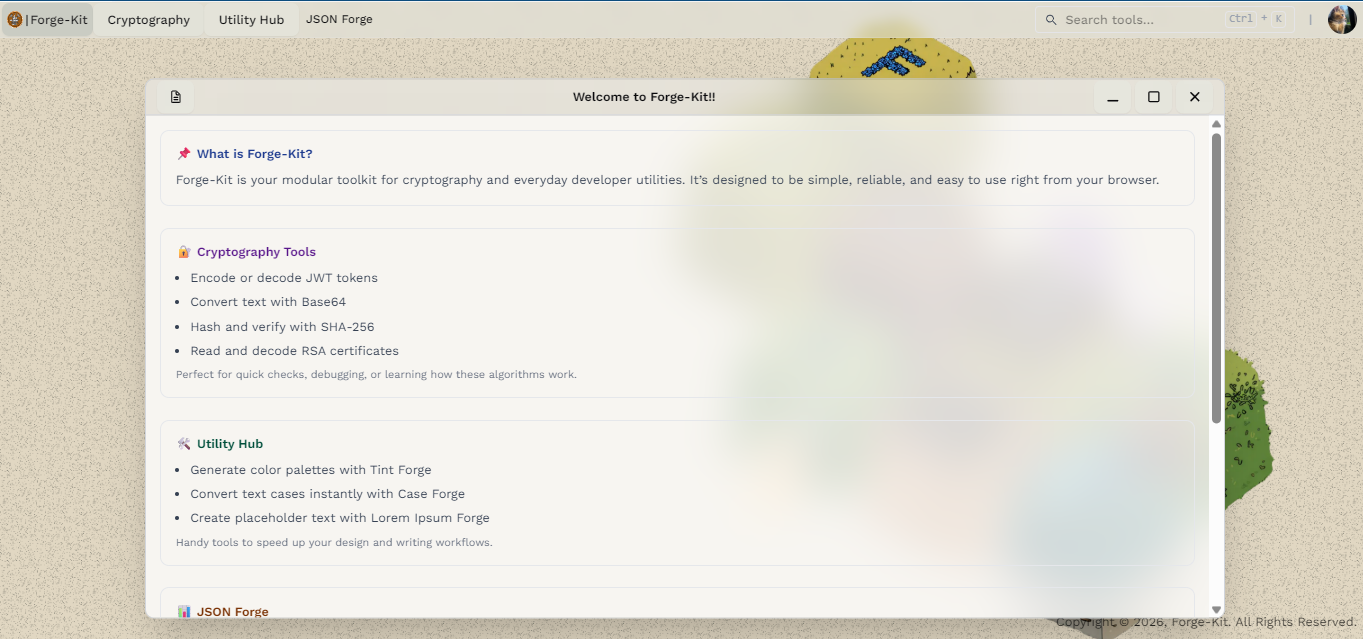
- 🔐 Cryptography Tools → JWT, Base64, SHA-256, RSA certificate parsing.
- 🎨 Utility Hub → Color palette generator, case converter, lorem ipsum generator.
- 📑 JSON Forge → Formatter and validator.
All of these were powered by API routes under /app/api/, making the toolkit extensible and easy to maintain.
Design Philosophy
We wanted Forge-Kit to feel like surfing through a modern GUI computer.
That’s why we leaned into glassmorphism-inspired design, responsive layouts, and a command palette for quick navigation.
The goal was not just functionality, but also delight — making everyday tasks feel smooth and visually engaging.
What We Learned
This project taught us the importance of modularity. By breaking tools into separate routes and components, Forge-Kit became easy to expand.
It also showed us how much design matters. A JSON validator or Base64 encoder might sound boring, but when wrapped in a clean, modern UI, it suddenly feels enjoyable to use.
Most importantly, working with my senior gave me a glimpse of how professional projects are structured — balancing utility, scalability, and user experience.
Conclusion
Forge-Kit wasn’t just another coding project — it was about reimagining how everyday developer tools could look and feel.
For us, it was a chance to blend engineering precision with design creativity, and the result is a toolkit we’re proud of.